by Kevin Snider
|
I recently obtained Canon's newest prosumer digital SLR, the 10.1 mega
pixel 40D. I will be providing first impressions here. More detailed
information will follow after I have spent more time with the camera. I
have been using a D60 and a digital rebel for some time now. I like the
feel of the larger D60 much better than the smaller digital Rebel. So the
40D has a familiar feel. It is similar in size and feel to the D60. This review is not a technical review by any means. I'll leave that to others. I just want to compare features and usability. The 40D is a vast improvement when compared to the D60. Which is now 5 generations old. The 6.3 mega pixel D60 was a intermediate camera between the D30 and the 10D. It does a fine job for what it was meant to do at the time it was introduced. But it is rapidly becoming a dinosaur by today's standards.
The new Canon 40D is sold as body only or with one of three different zoom
IS lenses. You probably know IS stands for image stabilizer. The lens has
elements that move inside to compensate for hand held motion. |
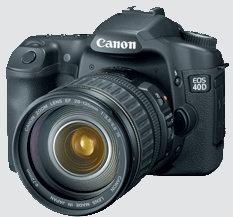
Photo courtesy canon.com
|
||||
|
Two of the lenses are EFS lenses. EFS lenses are designed to match the
smaller size of the digital sensor in several Canon cameras. Since the
digital sensor is smaller than a 35mm film frame the standard EF lenses
actually input a wider image view at the sensor than the sensor can
record. This results in what is referred to as the multiplication factor.
I wont get into the math, but the smaller sensor results in a 1.6X
magnification when using a standard lens on a digital SLR. For example, a
100mm lenses on a digital SLR produces an image equal to an image taken
with a 160mm lens on a 35mm or a digital SLR with a sensor the same size
as a 35mm film frame. EFS lenses will not work on 35mm cameras or digital
SLR's with full frame sensors. The third lens is a EF 28 - 135mm IS USM
lens. This lens will work with film or digital SLR cameras. This is the
lens that I received with my 40D. The 40D has the newest Digic 111 processor which works with the CMOS sensor to achieve faster and more accurate image processing. It can capture shots at up to 6.5 frames per second. The CMOS sensor has a broader exposure range than previous ISO 100 to 1600 standard and ISO 3200 possible through a user menu setting. The D60 only reached ISO 1000 and had noticeable increases in grain or digital noise at that setting. The broader exposure range offered by the increased ISO sensitivity should be a welcome asset when shooting in low light conditions. When the faster ISO settings are used with the IS lens the number of acceptable hand held low light shots should increase dramatically. My first use of the camera was late in the afternoon with the sun going down fast. I was anxious to try the higher ISO setting to compare the results with similar images taken with the D60, of course at lower ISO settings. The results were impressive. Even when set to a matching ISO 1000 the new 40D easily out performed the D60. In fact, it wasn't until I set the 40D at ISO 3200 that the results began to look similar in noise and grain to the results achieved with the D60 set at 1000 ISO. Notice I said similar. The 40D results were still more impressive than the D60. The 40D has so many new features, when compared to the models I am currently using, that I look forward to spending a lot of time shooting and learning the capabilities of this new camera. I'm sure it will help me expand the shooting I have been doing. I'll report on additional features and capabilities in the future. If you want additional technical details or product specs simply logon to canonusa.com, then products, then digital cameras. You can find information about all Canon cameras there. October 1, 07 Last night I had the opportunity to try out the low light capabilities of the 40D. I attended a comedy night at a local night spot as a guest of radio station 98.5 WUPS. I wanted to travel light. So the only equipment I carried was the 40D with the 28-135mm 3.5-5.6 IS lens attached. I could have gotten better results with my Canon 70-200 2.8 IS L lens. But, I wanted to try out the new equipment since that is the focus of this review. As with most bars and clubs in our area the lighting is minimal and the walls and ceiling are very dark. There was a small stage with 2 small spot lights trained on the performers from the front. The walls behind the stage are black. I set the camera to the H ISO setting. Which is a custom user function. It's the equivalent of ISO 3200. Then I adjusted the metering to the center spot. An area equal to about 3.8% of the screen. This was necessary because of the narrow light beams and the large black area around and behind the performers. The center spot meter would allow me to meter on the performers face and not average all that black into the exposure. Most of the shots were at the 135mm 5.6 setting. Since the IS feature on this lens does not work for both vertical and horizontal shooting I turned it off. All shots would be vertical and to leave the IS feature on would simply drain the battery faster without providing the stabilizer function. This is another reason I set the ISO to 3200. I needed as much light gathering ability as possible to get a fast enough shutter speed to avoid blurring the images. Due to performers movements and my own, I still managed to blur several shots. I missed the faster 70-200 2.8 IS L. It has stabilizers that work in both directions. So I know I would have saved more shots that blurred because I was guilty of moving. I still got a high percentage of acceptable shots. I picked one shot of each performer and printed 8X10 inch photos of them. The results, while not perfect, were sufficient for display in the bar where they were taken. The increased noise and grain look of the ISO 3200 actually lends itself well to these shots. |
|||||
 |
A couple of the handheld shots taken last night. I know without the ISO 3200 setting I would have had to use a tripod or some other method of support to achieve the sharpness I did get. As I said, when printed to 8X10 from the original raw file, these are actually pretty sharp. Even though these images look soft here on the web. |
 |
|||
| 1/50 sec @ F6.3 135mm ISO 3200 |
1/25 sec @ F6.3 135mm ISO 3200 |
||||
|
Overall, I don't believe I could have achieved these
images without the 3200 ISO setting with this lens. That is the goal of
this users review. Test the limits of the Canon 40D kit with the 28-135 IS
lens. Especially as compared to older Canon equipment I am familiar with.
I must say I am very pleased so far.
|
|||||